
Author profile

Priya Ramaswamy

Consumer Internet Editor

Represents the team's editorial perspective on everyday internet plan decisions for US households, from rural fixed wireless options to urban fiber competition and the fine print of multi-year ISP contracts.

About Priya Ramaswamy

Priya Ramaswamy is the editorial voice behind coverage of the practical side of choosing an internet plan in the United States, where availability and pricing can shift dramatically between zip codes. The writing under this byline unpacks the differences in service quality between dense metro markets and underserved rural areas, examines how equipment fees and price hikes affect total cost of ownership, and tests provider claims against published FCC data. The focus is on helping readers ask the right questions before signing up, switching providers or negotiating a renewal.

Priya Ramaswamy is an editorial persona for this website and represents the collective expertise and rigorous editorial standards of our US internet and telco market research team.

Articles by Priya Ramaswamy

Read practical US internet guides, plan explainers and comparison tips.

View all resources
Beetle car speeding down a city street symbolising slow internet speed.
Articles

Why Real-World Speeds Are Slower Than Advertised

It is normal for the speeds you actually experience to be lower than the figure your internet plan advertises, because advertised speeds are a maximum under ideal conditions rather than a guarantee. This guide explains the common reasons for the gap, from Wi-Fi and equipment to congestion and how speed is shared, and what you can do to get closer to your plan's potential.

By Priya Ramaswamy — Consumer Internet Editor

6 min
Digital code projection creating a tech-inspired abstract vibe illustrating internet speeds.
Articles

Symmetrical vs. Asymmetrical Speeds: What the Numbers Mean

Every internet plan lists two speeds, one for downloads and one for uploads, and whether they match tells you a lot about how the connection will behave. This guide explains what symmetrical and asymmetrical speeds mean, why different connection types are built one way or the other, and how to decide which balance suits your household based on how you use the internet.

By Priya Ramaswamy — Consumer Internet Editor

7 min
Wireless router with four antennas illustrating wifi internet speeds
Guides

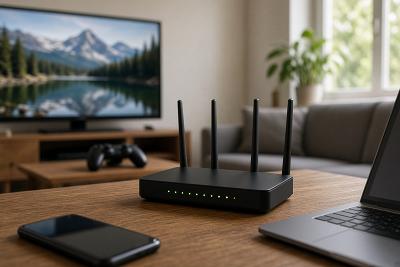
Wi-Fi vs. Your Internet Plan: Often It Is the Router

When home internet feels slow, the cause is frequently the Wi-Fi inside your home rather than the internet plan or provider. This guide explains the difference between your internet connection and your Wi-Fi network, why the router and its placement matter so much, and how to tell whether an upgrade to your equipment would help more than a faster plan.

By Priya Ramaswamy — Consumer Internet Editor

6 min
Interconnected light trails representing digital communication networks.
Guides

Why Fiber Offers Symmetrical Upload Speeds and Why It Matters

Fiber internet can offer symmetrical speeds, meaning your upload speed matches your download speed, because optical lines carry data in both directions without the design limits of older technologies. This guide explains why fiber is built this way, how it differs from cable and other connections, and why fast, steady uploads matter so much for remote work, video calls, file sharing, and cloud backups.

By Priya Ramaswamy — Consumer Internet Editor

8 min
A satellite orbiting Earth, showcasing the Mediterranean Sea and surrounding continents.
Articles

Satellite and LEO internet explained: price, latency, data limits

Satellite internet has changed significantly with the arrival of low-earth-orbit constellations. This guide explains how traditional geostationary satellite and newer LEO services actually differ, what drives their latency and pricing, how data limits typically work, and what to weigh up before choosing satellite as your home internet connection in the United States.

By Priya Ramaswamy — Consumer Internet Editor

11 min
Close-up of network cable connectors with colorful lighting.
Articles

DSL is being phased out: what copper-line customers should know

DSL service over copper telephone lines is being retired across the United States as carriers shift their investment into fiber and wireless networks. This guide explains why the transition is happening, what notice copper customers should expect, the practical alternatives available, and how to evaluate replacement options like fiber, cable, fixed wireless, 5G home internet and satellite.

By Priya Ramaswamy — Consumer Internet Editor

11 min

Loading…

No direct link